Skip to content
Moderna production area — process equipment

The ultimate cleanroom guide

Control the invisible for process excellence.

Quick navigation

In this ultimate guide to cleanrooms, discover step-by-step how to make your project a success, the mistakes to avoid, and the decisions that can influence the costs and timescales surrounding the design and construction of your controlled environment.


All you need to know about cleanrooms:

Why is such a high level of control essential?

Because contamination, whether due to dust, particles or micro-organisms, can lead to product failure, significant financial loss or risks to human and environmental safety, particularly in industries such as pharmaceuticals or micro-electronics. Internal practices also play a major role in contaminant management. Humans are the main source of contamination, accounting for up to 80% of contaminants in a cleanroom, underlining the importance of strict protocols in addition to dust control.

In addition, as industries move toward smaller, more precise products and place greater emphasis on contamination control, the demand for cleanrooms is steadily increasing.

Understand control parameters and their importance

Beyond simple dust management, a cleanroom requires rigorous control of multiple environmental parameters. The variability of these parameters can have a significant impact on the cost and complexity of the equipment required for your project.


The main parameters we control to ensure the quality of your environment

Icon — air filtration
Dust level (particles)
The concentration of airborne particles is at the heart of cleanroom classification.
Icon — temperature control
Temperature and humidity
Essential for product stability and staff comfort. Very low levels require specific, more expensive technologies such as desiccant units.
Pressure gauge icon (kPa)
Differential pressure
Essential for containment (negative pressure) or protection (positive pressure).
Icon — static electricity
Static electricity

Controlled by dissipative materials to protect sensitive electronic components.

Icon — CO2
CO2 levels
Crucial for cell and plant culture applications.
Icon — lighting
Light and vibration
For optical processes or high-precision calibration equipment.
Icon — chemical compounds
VOC levels
For microelectronics, photolithography and optics processes, to control the risk of defects in your products.
Icon — materials
Choice of materials
This is a very important factor when it comes to ensuring the compatibility of our installations with your processes.

Discover our article on the 6 main ways to maintain air quality in your cleanrooms.

Which certification level meets your needs?

Navigate ISO classifications

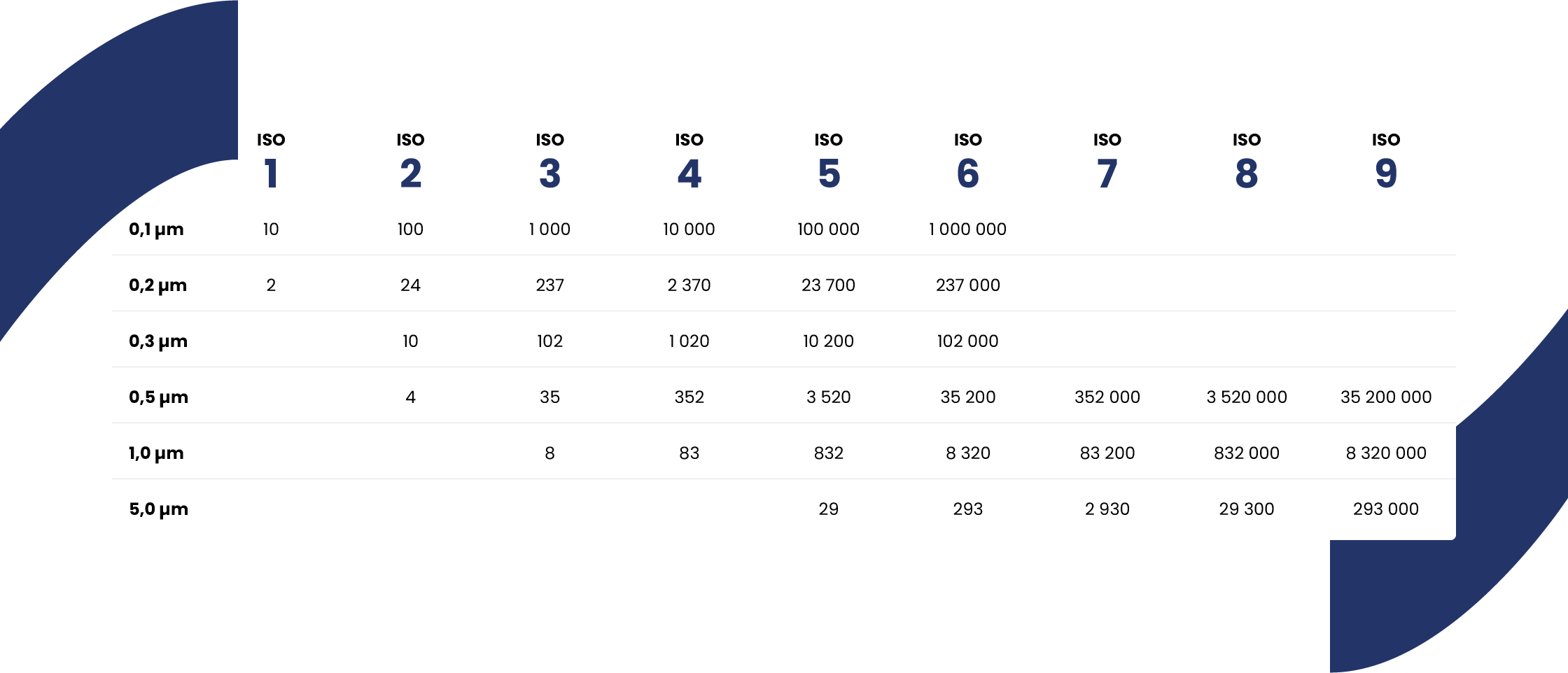
To assess air cleanliness, cleanrooms are classified according to strict standards, the most widely recognized of which is ISO 14644-1. This standard defines cleanliness levels according to the number and size of particles per cubic meter of air. The lower the ISO number (ISO 1 to ISO 9), the stricter the cleanliness and the more complex and expensive the construction.

ISO cleanroom classification chart

ISO classes 6, 7 and 8 are the most frequently requested by our customers. Conversely, the lower classes (ISO 5 and below) involve much more complex systems, such as fully filtered ceilings, laminar (straight down) airflows and perforated raised floors for optimum air return, significantly increasing logistical complexity and costs.

In addition to ISO standards, Consab also integrates Good Manufacturing Practices (GMP) for industries requiring greater regulatory compliance, such as pharmaceuticals. We tailor product design and selection to meet the specific requirements of each customer and process.

Strategic investment: understanding cleanroom costs

The cost of a cleanroom is influenced by several key factors. Understanding these levers will help you optimize your investment and avoid surprises.


Key factors influencing cost:

  • ISO level

    This is one of the most decisive factors. A stricter ISO class (e.g. ISO 4 vs. ISO 7) requires higher-performance filtration systems, a greater number of air changes per hour, and more specific materials, drastically increasing costs.

  • Type of architecture

    Modular: Prefabricated panels, rapid installation, uniform quality and finish, less disruption to adjacent areas, high flexibility (dismantling, relocation) and ideal for evolving configurations, but potentially higher initial cost, limited customization and lead times before delivery to site.
    Non-modular: Great flexibility of design and materials (adapted to the constraints of the existing building), lower initial cost, can be integrated more easily into a complex existing infrastructure, but more dust, noise and disruption, difficult to modify or dismantle and a longer construction period.

    Discover our article detailing possible architectures for a cleanroom project

  • Temperature and humidity control

    Very precise requirements or extreme conditions (very cold, very hot, very dry) call for more sophisticated HVAC systems (e.g. desiccant units for less than 40% relative humidity), significantly increasing the budget.

  • Differential pressure management (positive/negative)

    A negative pressure room (to contain hazardous products) is generally more expensive than a positive pressure room (to protect the product). This is due to the need to replace exhaust air with treated fresh air, requiring larger HVAC units and higher energy costs.

  • Area

    Cost per square foot is an indicator, but larger projects can benefit from economies of scale on materials and labor, while smaller ones can be more focused on technical specifics.

  • Existing building structure

    Adaptations needed to support heavy equipment or comply with local standards can add costs.

  • Other parameters

    The price of a cleanroom does not depend solely on its surface area or type of construction (modular or conventional). A determining factor is the level of control over the environmental parameters required by the process or application. Among the most influential parameters are: volatile organic compounds (VOCs), static electricity, brightness and vibration.


Optimize your investment: Rather than aiming for the biggest or "cleanest" cleanroom, Consab helps you define your real needs. For example, proper pre-filtration can extend the life of HEPA filters by 10 to 15 years, significantly reducing long-term maintenance costs. Similarly, understanding that sometimes only a small portion of your production line needs to be in a cleanroom can generate significant savings.

For a quick estimate of your project's potential costs and the impact of your choices, don't hesitate to use our interactive Cost Calculator.

For a quick estimate of your project's potential costs and the impact of your choices, feel free to use our interactive Cost Calculator.

Details about your project

1.
2.
3.
4.
5.
6.
7.
8.
9.
20°C
-40°C 40°C
10.
5°C
0°C 20°C
11.
12.
45%
0% 100%
13.
15%
0% 25%
19.
20.
21.
22.
23.
24.
25.
26.
27.
28.
29.
30.
31.
32.
33.
34.
35.
36.
37.
38.
39.
40.
41.
42.
43.
44.
45.
46.
47.
48.
49.
50.
51.
52.
53.
54.
55.
56.
57.

Average price of a project with the selected parameters*

prix_moyen
$
prix_min
$
prix_max
$
Result Title
mult_superficie
mult_type_projet
mult_iso
mult_hauteur
mult_installation
mult_temperature
addition_humidite
mult_humidite
ST_SUP
ST_PROJET
ST_ISO
ST_HAUT
ST_INST
ST_TEMP
ST_HUM

Typical price range for this type of project, based on additional parameters to be defined with your Consab expert.

This budget range is meant to give you an approximate view based on the project parameters you entered. To learn what can make your project's cost vary from the minimum to the maximum average range, read our article What influences the cost of a cleanroom? The key factors to know.

* Please note that Consab's calculator provides an approximate estimate and does not constitute an offer to sell or an official quote. Several parameters specific to your processes and requirements can affect the price of your project. For a more precise estimate, tailored by a Consab expert, please book a free consultation and we will be happy to assist you with personalized service.
 

Cleanrooms and controlled environments: a crucial distinction.

Although every cleanroom is a controlled environment, a controlled environment is not necessarily a cleanroom. The fundamental nuance lies in the level of control of airborne particles.

A cleanroom is specifically designed to moderately to drastically limit dust to strict ISO standards (from ISO 1 to ISO 9). However, a controlled environment can focus on the precise control of a multitude of other essential parameters, such as temperature, humidity, CO2 levels, static electricity or even vibration. For some processes, the variability requirements of these parameters can be extremely stringent, even more complex to manage than simple dust control in a cleanroom.

For an in-depth understanding of these multiple variables, the use cases where a controlled environment is sufficient, and the technical distinctions between these two types of space, we invite you to consult our page dedicated to Controlled Environments.
MAKING A SUCCESS OF YOUR PROJECT

The 8 key steps: from your initial need to the realization of your customized cleanroom

At Consab, designing and building a cleanroom requires meticulous precision and in-depth expertise to master the invisible and guarantee process excellence. Our support process is structured to guide you through each step, adapting to the complexity of your requirements and your level of cleanroom familiarity.

1
Clarification and validation of initial requirements
We start with an in-depth discussion to understand your processes, the critical parameters to be controlled and the level of ISO cleanliness you're looking for. Even if you already have a clear idea (for example, "an ISO 7 cleanroom"), we help you validate and refine these requirements, exploring the impact of variations on your product quality and associated costs. We also address the need for support areas such as airlocks, essential for managing cleanliness gradients and preventing contamination.
To explore and validate your needs, schedule a meeting with a Consab expert.
Illustration — step 1 of a cleanroom project: initial consultation
2
Site analysis and preliminary assessment
If necessary, a site visit is carried out to assess existing installations. This step is crucial to identify architectural and structural constraints, the optimum location for air handling units (HVAC) and service connections (electricity, plumbing), which can influence the design and budget of your cleanroom.
Illustration — step 2 of a cleanroom project: needs analysis
3
Pre-engineering and budget preparation
Based on the defined requirements and our preliminary analysis, we carry out a rapid pre-engineering phase. This enables us to size the necessary systems and equipment (filtration, HVAC, pressurization) and provide you with an initial budget estimate. At this stage, we clarify the impact of crucial choices - such as ISO level, type of architecture (modular or non-modular), pressure management (positive or negative) and accuracy of environmental controls - on the overall cost of your project.
Illustration — step 3 of a cleanroom project: concept definition
4
Detailed engineering and choice of solutions
Once the budget has been validated, our multidisciplinary engineering teams (structural, ventilation/HVAC, electrical, plumbing) draw up precise plans and specifications. It's at this stage that customization takes on its full meaning, integrating the specifics of your industry (e.g. modularity for microelectronics, flush surfaces for pharmaceuticals), the materials required, and compliance protocols (ISO, GMP). Our in-depth knowledge of all trades enables us to anticipate potential challenges right from the design phase.
Illustration — step 4 of a cleanroom project: detailed engineering
5
Supply management and pre-site coordination
We select specialized equipment and materials from reliable suppliers, leveraging our independence from manufacturers to choose the most relevant and optimized solutions for your project. Detailed logistics planning is established for long lead items, ensuring smooth coordination with the start of construction.
Illustration — step 5 of a cleanroom project: site preparation
6
Custom construction and installation
The construction phase is rigorously managed, based on our integrated design-build approach. This enables us to minimize surprises, delays and additional costs often encountered on construction sites. Our teams, accustomed to the constraints of each industry, adapt the installation to specific site conditions and unforeseen logistical challenges. We maintain agile and transparent communication with you and all stakeholders for rapid adjustments during the course of the project.
Illustration — step 6 of a cleanroom project: construction
7
Commissioning and ISO certification
Once construction is complete, we support you in commissioning the equipment (HVAC and pressurization systems, controls, etc.). This is followed by certification of your cleanroom to ISO 14644-1. This certification is essential and attests that your environment meets the required particle cleanliness levels. We work with third-party certifiers to guarantee the objectivity of the results. Additional tests (temperature, humidity, static electricity, etc.) are carried out as required, depending on the specific requirements of your project.
Illustration — step 7 of a cleanroom project: testing and certification
8
Documentation and post-project support
The project concludes with the delivery of a complete file including "as-built" drawings, user and maintenance manuals for all equipment, and warranties. For optimum, long-term use of your cleanroom, we also provide practical guides on good human behavior practices, and advice on regular filter servicing, sensor calibration and regular maintenance. You'll also benefit from our ongoing support to answer your questions and optimize your plant's performance over the long term.
Illustration — step 8 of a cleanroom project: commissioning
Consab expert

THE CONSAB DIFFERENCE

Our strength lies in our ability to offer you an unrivalled consulting service thanks to our:
Independence from manufacturers:

Recommendations based on your real needs, budget, schedule and technical requirements, not on an imposed catalog.


Integrated design-build expertise:

The ability to manage both design and construction, allowing you to anticipate site challenges right from the consultation phase, thus avoiding surprises, delays and additional costs.


Agile, customized approach:

We can take charge of your entire project, or focus on a specific stage.

30 YEARS OF CLEANROOMS AND CONTROLLED ENVIRONMENTS

Discover Consab's wide range of custom projects.

These achievements testify to our ability to take on the most demanding projects, delivering solutions that not only meet technical specifications, but also enable our customers to significantly increase their production capacity and achieve their strategic ambitions.

Want more information?

Consab offers you a wealth of resources!

Learning center
Access detailed materials that demystify technical concepts, answer frequently asked questions about costs, ISO classifications, materials, and best practices for using and maintaining your cleanroom.
Explore these contents
Documentation and checklist
Discover our documentation, including our cleanroom construction checklist, filtration systems, pressure management, and the different wall types (modular vs. non-modular) for a better understanding of the technical aspects of such a project.
Go to the Documentation page

Achievements and case studies
Immerse yourself in detailed accounts of our past projects, with the challenges, Consab solutions and concrete results achieved for our customers.
Discover our achievements
Blue and Pink Soft Magazine Cover Mockup Instagram Post

Ready to make your cleanroom project a reality?

Whether you're in the exploration, design or construction phase, our team can adapt to your needs. Schedule a call with us today!